FORWARD DEPLOYED ENGINEERING · CAREER GUIDE
Software Developer to Forward Deployed Engineer (SDE to FDE): How to Make the Switch
In this guide
Yes, a software developer (SDE) can move into a Forward Deployed Engineer (FDE) role, and most of the job is work an SDE already does: writing production code, debugging, building APIs and shipping releases. In the five real FDE job posts below, between roughly 30% and 60% of the listed lines describe everyday SDE work. The rest is learnable: working directly with customers, scoping a fuzzy business problem, and building and checking AI features. The usual switch takes three to six months of focused practice and one strong customer-style project.
If you write code for a living, you have probably seen the title Forward Deployed Engineer turning up in your job alerts. The obvious question is whether it is a different career or the same job with a new name. The honest answer sits in between. An FDE is still a software engineer. The difference is where the work happens and who it is for: an SDE usually builds one product for many users, while an FDE takes a product or platform into one customer’s world and makes it work there, with real data, real systems and real deadlines.
This guide reads five live FDE job posts line by line, from a new-graduate role to a senior role that asks for nine years. You will see exactly which lines you already cover as an SDE, which lines add an AI layer on top of familiar work, and which lines are genuinely new. Then you get a practical plan for freshers and for experienced developers. For the basic definition of the role, start with what a Forward Deployed Engineer is.
SDE vs FDE: what stays the same and what changes
The core engineering stays. You still design systems, write and review code, test, deploy and fix what breaks. What changes is the shape of the problem. An SDE usually receives a ticket that a product manager has already written. An FDE often receives a business complaint, such as “our support team cannot keep up with tickets”, and has to turn it into a clear technical plan before any code is written.
The second change is the audience. An SDE mostly talks to other engineers, product managers and testers. An FDE talks to the customer’s engineers in the morning and the customer’s operations head in the afternoon. The same idea has to be explained in two languages: one technical, one about money, time and risk.
The third change is ownership. Many SDE roles end when the feature is merged and released. FDE roles usually continue until the customer is actually using the system, which means installation, integration with their tools, training, handover notes and fixing the first real problems.
| Area | Typical SDE | Typical FDE |
|---|---|---|
| Starting point | A written ticket or feature spec | A business problem described by a customer |
| Code | Product features in one codebase | Integrations, custom builds and fixes across the customer’s systems |
| Main audience | Engineers and product managers | Customer engineers, business owners and your own product team |
| Done means | Merged, tested and released | Live, used by the customer and handed over |
| AI work | Optional in many teams | Common: building, connecting and checking AI features |
| Travel and meetings | Low | Moderate; some roles include customer visits |
If you enjoy debugging other people’s systems, explaining your choices and seeing a result land with a real user, the change will feel natural. If you prefer long stretches of quiet, deep work on one codebase, read the job posts carefully before switching, because the amount of customer contact varies a lot between employers.
Five real FDE job posts, read line by line
The fastest way to judge the overlap is to read actual job descriptions. The five posts below cover a range of experience: one new-graduate role, one early-career role in Bengaluru, two mid-level roles in India and one senior role open remotely in India. Each screenshot shows the employer’s own page.
For each post, every responsibility and requirement line is sorted into one of three groups. Already SDE work means a typical product developer does this today. SDE work with an AI layer means familiar engineering applied to AI features. New for most SDEs means skills that usually come from customer-facing or specialist roles. Location and work-permit lines are left out because they are not skills.
1. LiteLLM: Forward Deployed Engineer (New Grad)
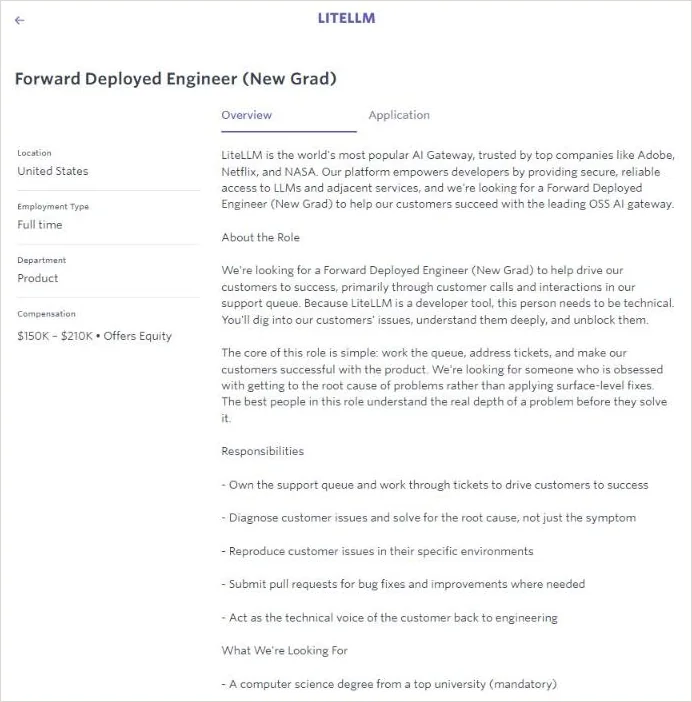
This is the clearest example of how close an entry-level FDE role can be to junior developer work. Three of the five responsibilities are classic debugging: find the root cause instead of patching the symptom, reproduce the issue in the customer’s own setup, and submit pull requests with the fix. Any developer who has worked through a bug backlog has done this.
The new parts are owning a customer support queue and acting as the customer’s voice inside the engineering team. On the requirements side, the post asks for a computer science degree, strong fundamentals and a habit of digging into problems deeply, which a good SDE already has. The new requirements are a strong focus on customers and comfort with a high volume of tickets.
Our count: about 7 of 11 lines are already SDE work (roughly 60%), and 4 are new. For a fresher, this kind of post shows that the entry point is strong debugging and clear communication, not years of experience.
2. Prodigal: Forward Deployed Engineer, AI Agents (Bengaluru)
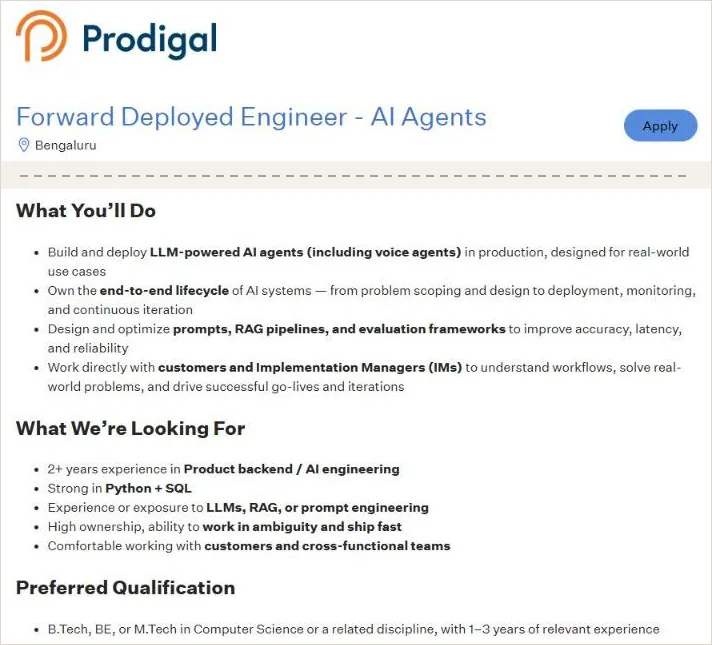
This role suits a developer with one to three years of backend experience. The requirements read like a backend job: two or more years in product backend work, strong Python and SQL, high ownership and the ability to ship quickly. Owning a system from scoping through deployment, monitoring and improvement is also standard for a backend developer in a small team.
The AI layer is building and deploying AI agents, including voice agents, in production. The new parts are designing prompts, connecting the AI to the company’s own documents and building ways to check answer quality, plus working directly with customers and implementation managers on go-lives.
Our count: 5 of 10 lines are already SDE work (about half), 1 is SDE work with an AI layer, and 4 are new. A backend developer who adds one working AI agent project to their portfolio covers most of the gap.
3. Bottomline: Forward-Deployed AI Engineer (India)
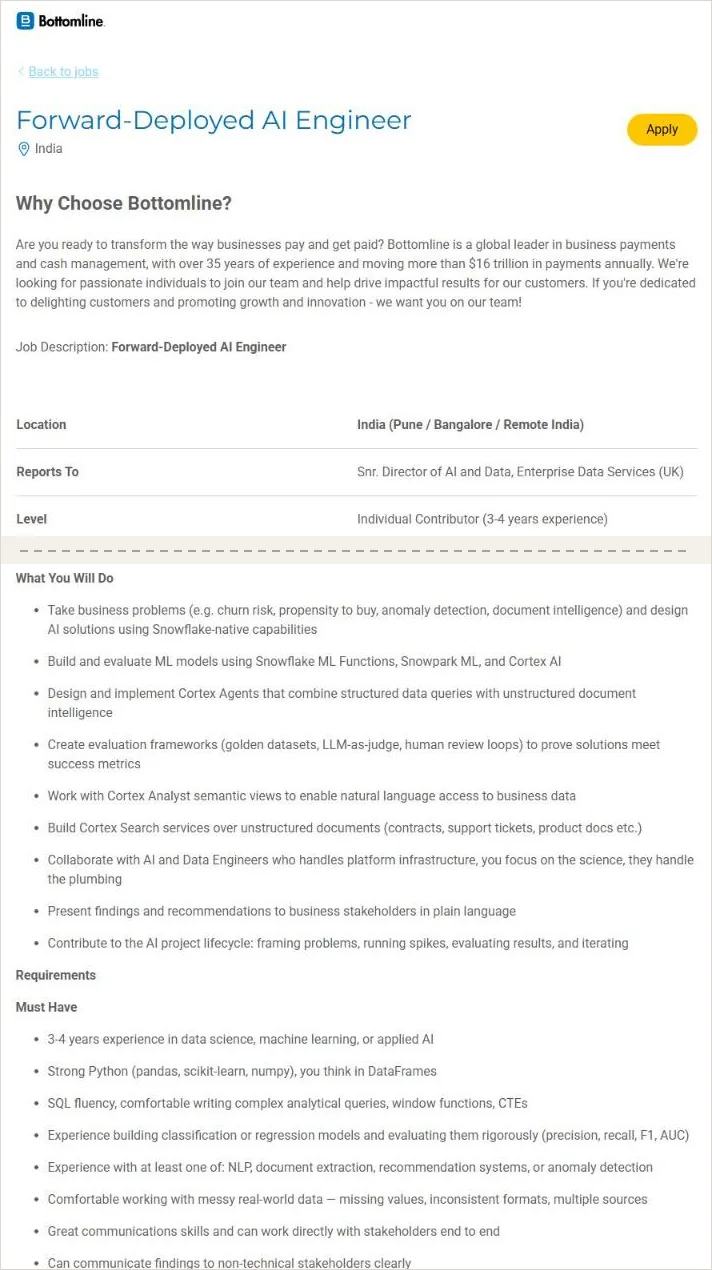
Not every FDE role is close to product development. This one leans towards data science. It asks for three to four years in data science, machine learning or applied AI, and it lists tasks such as building prediction models, measuring their accuracy and presenting findings to business teams.
An SDE still recognises a good part of it. Strong Python, fluent SQL with complex queries, handling messy real-world data, working alongside platform engineers and building in short iterations are all normal developer work. Several lines, such as building search over contracts and support tickets, are familiar engineering with an AI layer on top.
Our count: 5 of 17 lines are already SDE work (about 30%), 3 add an AI layer, and 9 are new. This is the post to show that “FDE” covers a range. A developer aiming at roles like this needs real practice with data and model evaluation, not only with application code.
4. Telnyx: Forward Deployed Engineer, India (Bangalore)
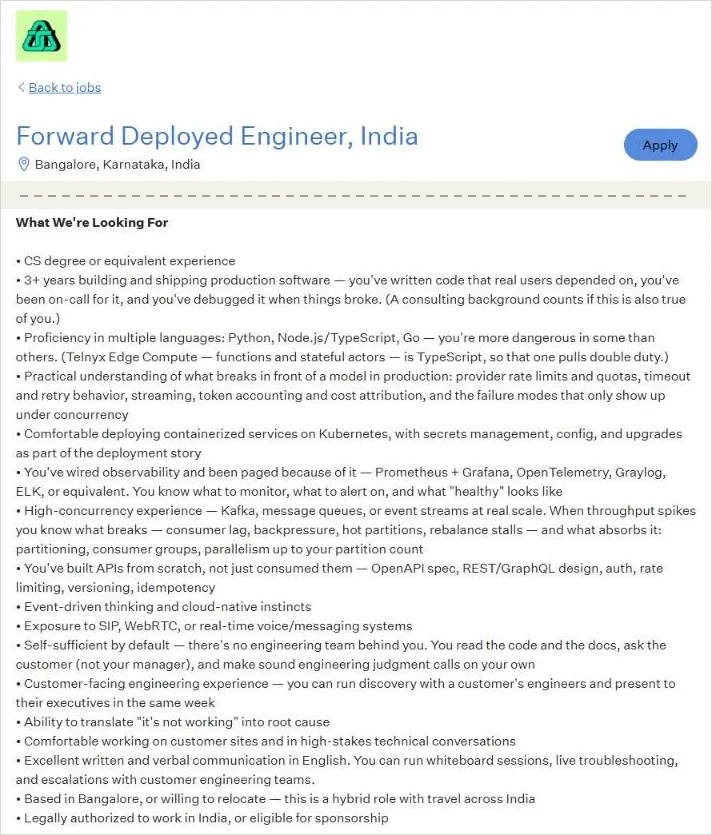
This requirements list could almost be copied from a senior backend job: three or more years shipping production software, being on call, Python, Node.js or Go, deploying containers on Kubernetes, setting up monitoring and alerts, handling high traffic with message queues such as Kafka, and building APIs from scratch with authentication, rate limits and versioning.
The AI layer is knowing what breaks when an application calls an AI model in production: rate limits, timeouts and retries, streaming responses and tracking cost per request. These are classic reliability problems in a new setting. The new parts are real-time voice systems, customer-facing discovery, working on customer sites, running whiteboard sessions with customer teams and being self-sufficient with no engineering team behind you.
Our count: 9 of 15 skill lines are already SDE work (about 60%), 1 adds an AI layer, and 5 are new. For a backend developer with three to six years of experience, this is the kind of post where the switch is mostly about customer skills.
5. Databricks: Senior Forward Deployed Engineer, Sr FDE (L5), Remote India
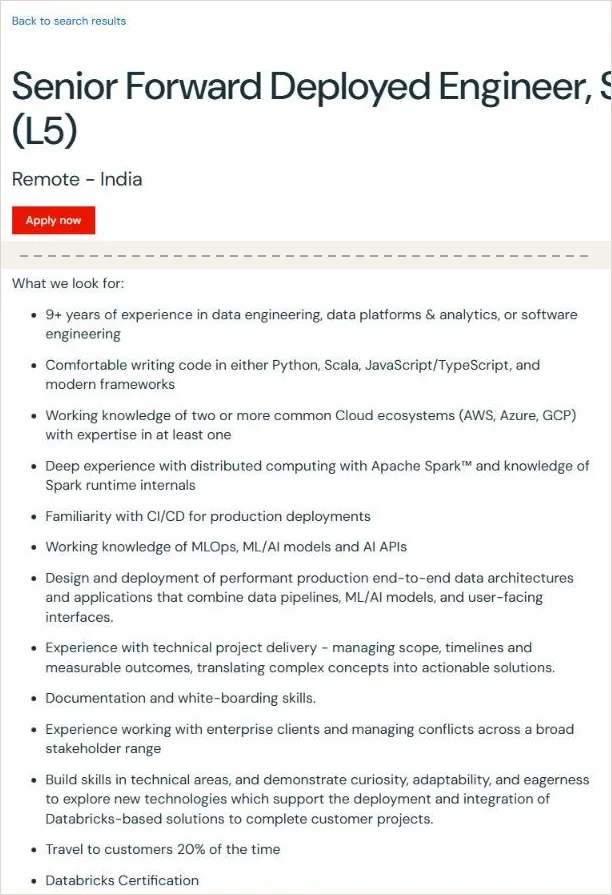
At the senior end, the overlap is still large. The post accepts software engineering as a background and asks for coding in Python, Scala or JavaScript/TypeScript, knowledge of two or more cloud platforms, automated build and release pipelines, documentation and whiteboarding, and design of complete production systems that combine data, AI and user-facing screens. A senior SDE or tech lead does most of this already.
The AI layer is working knowledge of machine learning operations and AI services. The new parts are deep expertise in Apache Spark, managing project scope and timelines with enterprise clients, handling disagreements across many stakeholders, travelling to customers about 20% of the time and holding the employer’s own certification.
Our count: 7 of 13 lines are already SDE work (about 54%), 1 adds an AI layer, and 5 are new. Senior developers moving into roles like this usually need one platform specialisation and proof of client-facing delivery.
What the five posts have in common
| Employer and role | Experience asked | Already SDE work | Biggest new area |
|---|---|---|---|
| LiteLLM, FDE (New Grad) | New graduate | About 60% | Owning a customer support queue |
| Prodigal, FDE AI Agents | 1–3 years | About 50% | Building and checking AI agents |
| Bottomline, Forward-Deployed AI Engineer | 3–4 years | About 30% | Data science and model evaluation |
| Telnyx, FDE India | 3+ years | About 60% | Customer discovery and on-site work |
| Databricks, Senior FDE | 9+ years | About 54% | Platform depth and client delivery |
Three patterns stand out. First, every post asks for production coding. None of them treats the FDE as a non-technical role. Second, every post adds customer contact, either as a support queue, as go-live work or as on-site discovery. Third, four of the five posts mention AI work directly, and the fifth is an AI gateway company. AI is not optional for most FDE roles in 2026.
The percentages come from a simple line count, so treat them as a guide rather than a precise score. A short line such as “strong Python” counts the same as a long line about architecture. Still, the direction is clear: an experienced SDE starts with roughly half of a typical FDE job description already covered.
The five skills most SDEs need to add
1. Discovery: turning a complaint into a plan
Customers rarely say “build me a service with these endpoints”. They say “our claims team spends four hours a day copying data”. Discovery means asking the questions that turn that sentence into a plan: who does the work today, which systems hold the data, what counts as success, what must never go wrong and who approves the change. Practise by interviewing a friend who runs a small business or works in operations, then writing a one-page plan from the conversation.
2. Building and checking AI features
Most FDE roles now involve connecting an AI model to a customer’s data and workflow. The engineering is familiar: calling an external service, handling failures, storing results and testing. The new parts are writing clear instructions for the model, letting it look up the customer’s own documents, and checking answer quality against a set of known-good examples before anything goes live. The FDE skills guide covers this list in more depth.
3. Integration across messy systems
Product developers often work in one clean codebase. FDEs connect to older systems, spreadsheets, internal tools and third-party services they do not control. Strong habits here include reading unfamiliar documentation quickly, writing small test scripts against a live service, logging everything and designing for partial failure.
4. Explaining technical choices in business terms
You will need to explain why one option is safer, cheaper or faster in language a non-engineer can act on. A good exercise is to take a design decision from your current job and explain it in three sentences: what the choice was, what it costs and what risk it removes. If a manager outside engineering can repeat it back, it works.
5. Owning the handover
FDE work ends when the customer can run the system without you. That means a short runbook, clear notes on known limits, a list of who owns what and a check that the customer’s team can handle the common problems. Many SDEs already write good documentation; the shift is writing it for an outside team.
If you are a fresher or have less than two years
Entry-level FDE roles exist, as the LiteLLM post shows, but they are fewer than mid-level roles. Employers hiring freshers look for three signals: strong coding fundamentals, evidence that you can debug unfamiliar problems, and clear written communication.
Build one project that looks like real customer work instead of a tutorial clone. For example, pick a small business process, such as handling customer questions for a local coaching institute, and build a working assistant that answers from the institute’s own documents, passes difficult questions to a human and keeps a log. Write a short page describing the problem, the constraints, what you built, how you tested it and what you would change. That page often matters as much as the code.
Contribute small fixes to open-source developer tools, especially in the AI tooling space. Reproducing an issue someone else reported and submitting a fix is almost exactly what the LiteLLM post describes. A few merged pull requests are strong evidence for an entry-level FDE application.
Do not skip the SDE fundamentals while chasing the new title. Data structures, databases, networking basics and clean code are still the foundation. Many freshers reach an FDE role after one or two years as a backend or support engineer, and that route is perfectly sound.
If you have three to ten years as an SDE
Your production experience is the most valuable thing you bring. Employers like Telnyx and Databricks ask directly for people who have shipped software, been on call and debugged real failures. You do not need to start again; you need to add proof of customer-facing delivery and AI work.
Look inside your current job first. Volunteer for integration work with a client, join customer escalation calls, offer to help the sales or solutions team with a technical demo, or lead a pilot of an AI feature. Six months of this gives you real stories for interviews and real lines for your resume.
Choose a direction based on your background. Backend and platform developers fit roles like Telnyx, where reliability, APIs and high traffic matter. Data engineers and developers who enjoy SQL and analytics fit roles like Databricks or Bottomline. Full-stack developers fit startup FDE roles where you build a complete working tool for one customer in a few weeks.
Expect the interview to test judgment more than puzzles. You will be asked how you would handle a customer whose request conflicts with your product’s design, how you would scope a vague problem in a first meeting and how you would explain a failed deployment. Prepare three or four true stories from your own work for each of these.
A practical 90-day plan for the switch
Days 1 to 30: learn the role and the AI basics. Read twenty real FDE job posts and highlight every line you cannot yet prove. Build a small AI feature end to end: call a model, connect it to a few of your own documents, write ten known-good questions with expected answers and measure how often it gets them right. Read the FDE roadmap for a fuller checklist.
Days 31 to 60: build one customer-style project. Pick a realistic business problem and treat it like a client engagement. Write the discovery notes, a one-page scope, the build, the tests, a short demo video and a handover note. Make it run somewhere other than your laptop, with logging and basic monitoring, because that is what customers need.
Days 61 to 90: show it and apply. Rewrite your resume around outcomes, publish the project write-up, and practise explaining it in five minutes to a non-technical listener. Apply to a focused list of roles where your background matches at least half of the post. Use the FDE jobs in India guide to see where these roles are being advertised.
Ninety days is a realistic minimum for a developer with a few years of experience who can practise for an hour or two most days. Freshers and developers without backend experience should plan for longer.
How to rewrite your resume for FDE roles
An SDE resume usually lists technologies and features. An FDE resume should show problems, people and outcomes. Keep the technical depth, but frame each line around who had the problem and what changed after your work.
Before: “Built REST APIs in Node.js and integrated payment gateway.”
After: “Worked with the finance team to replace manual payment checks; built the API integration with the payment provider, cut reconciliation time from two days to two hours and wrote the handover guide used by the support team.”
Before: “Fixed production bugs and improved logging.”
After: “Reproduced and fixed a recurring failure reported by three enterprise clients; added monitoring that now alerts the team before customers notice.”
Add a short section near the top called “Customer-facing work” if you have any: client calls, demos, pilots, on-site visits or escalations. Even two lines help, because this is the area recruiters check first when they read a developer’s resume for an FDE role.
What FDE interviews test that SDE interviews do not
Most FDE hiring processes still include coding. Expect practical tasks such as building a small service, debugging a broken repository or connecting two systems, rather than only algorithm puzzles. The extra rounds are where SDEs are less prepared.
A common round is a case discussion: the interviewer plays a customer with a vague problem and watches how you ask questions, narrow the scope, propose a first version and explain trade-offs. Another is a presentation of a past project to a mixed audience. Some employers add a written exercise, such as an email to a customer explaining a delay. The FDE interview preparation guide walks through these rounds with worked examples.
The best preparation is rehearsal out loud. Record yourself scoping a problem in ten minutes, then listen back. Check whether you asked about users, data, success measures and risks before suggesting a solution.
Is the switch right for you?
The move suits developers who like variety, enjoy seeing their work used directly and are comfortable saying “I don’t know yet, let me find out” in front of a customer. It also suits people who feel their current role is too far from the business and want their technical choices to show up in outcomes they can see.
It may not suit you if customer meetings drain your energy, if you dislike switching contexts several times a day or if you want to specialise deeply in one system for years. There is no wrong answer here. Many strong engineers try FDE work for two or three years and then return to product engineering with a much better sense of how customers actually use software.
Read the posts you are interested in with the three-group method from this guide. If at least half the lines are already your daily work and the new half sounds interesting rather than stressful, the switch is likely a good fit.
Frequently asked questions about moving from SDE to FDE
Can a software developer become a Forward Deployed Engineer?
Yes. Most FDE job posts ask for production coding experience, and in the five posts reviewed here roughly 30% to 60% of the listed lines are everyday SDE work. The main additions are customer-facing skills and AI feature work.
Is an FDE role a step down from an SDE role?
No. FDE roles are engineering roles with more customer ownership. Senior FDE posts, such as the Databricks role asking for nine years, sit at the same level as senior engineering roles.
Can a fresher apply for FDE jobs?
Yes, though entry-level posts are fewer. New-graduate roles such as LiteLLM’s value strong debugging, open-source fixes and clear communication. Many freshers also reach FDE work after one or two years as backend or support engineers.
How long does the switch from SDE to FDE take?
For a developer with a few years of experience, three to six months of focused practice is realistic. That includes building one customer-style AI project and preparing true stories about customer-facing work.
Do I need to learn AI to become an FDE?
For most roles, yes. Four of the five posts reviewed mention AI work directly. You need to be able to connect a model to real data, handle failures and check answer quality, not research new models.
Which SDE background fits FDE roles best?
Backend, platform, full-stack and data engineering backgrounds all fit. Backend developers match reliability-heavy roles, data engineers match data platform roles, and full-stack developers match startup roles that build complete tools for customers.
Plan your move from SDE to FDE
Review FDE training in India to see the curriculum, the customer-style projects and the mentor reviews. FDE training in India or talk to a course advisor on WhatsApp.
Sources and review date
All five employer job pages were checked and captured on 20 November 2026. The line counts are an editorial reading of each post’s listed responsibilities and requirements; location and work-permit lines were excluded. Job posts can close or change after this date.